
Little Rock Directory Collections
Historic Little Rock city directories are split among printed volumes, microfilm, licensed databases, and digital collections. The Roberts Library Research Room and Butler Center form the main local directory desk. Their holdings include printed directories, Arkansas books, manuscripts, newspapers on microfilm, and yearbooks. Nineteenth-century Little Rock volumes and later R. L. Polk editions survive in irregular runs. No official public shelf list gives a closed year-by-year run, so exact volume availability should be confirmed with library staff before a visit.
| Collection | Years represented | Where held | Access |
|---|---|---|---|
| Alphabetical directories | Nineteenth century onward, incomplete runs | Roberts Library; selected digitized volumes | Research room, catalog, or online copy |
| Polk reverse directories | Later twentieth century; exact run unpublished | Roberts Library | In-person shelf check |
| Little Rock school yearbooks | Many schools; more than 100 digitized by 2022 | Butler Center digital collections | Free online and research room |
| Arkansas newspapers | Nineteenth century onward by title | Roberts Library and State Archives | Microfilm; licensed databases on site |
| Federal census schedules | Released decades through 1950 | NARA and genealogy databases | Online; licensed access also at Roberts |
| Pulaski County Historical Review | 1953 to present | Historical society and Roberts Library | Publication and index research |
The table states what the research can support without inventing missing shelf dates. A call to the research room is the sound way to confirm a specific Polk year, publisher, format, or call number.
Little Rock's Directory Desk
Roberts Library stands at 401 President Clinton Avenue and can be reached at 501-320-5700. Its second-floor Research Room provides open and closed stacks, microfilm, manuscript finding aids, and staff support. The published schedule is Tuesday through Friday from 10 a.m. to 5 p.m. and Saturday from noon to 4 p.m.; check the current schedule before travel. On-site access also includes Ancestry, Newspapers.com, and Fold3. Those tools help bridge a name found in a printed volume to a census household, an obituary, or a military lead.
Bring the person’s full name, spelling variants, likely neighborhood, and a bounded range of years. Ask staff about both the alphabetical volume and its reverse section. Photograph the title page and abbreviation key before the entry. This small habit preserves the publisher, year, and meaning of marks that would otherwise become guesswork.
Note: An unpublished shelf cutoff is a reason to call the library, not a reason to assign a made-up last directory year.
Reading Little Rock Directory Entries
A Little Rock directory entry compresses several facts into one short line. The surname and given name or initials lead the entry. A spouse may follow in parentheses. Occupation, employer, home address, and business address often appear in a dense run of abbreviations. A widow may be marked with “wid” and a deceased spouse’s name. Some editions use owner or renter symbols, but those marks mean nothing until checked against that volume’s own key.
| Name | Surname, given name or initials; spelling may shift between years. |
|---|---|
| Family clue | Spouse in parentheses or a widow notation in some editions. |
| Work | Occupation, employer, firm name, or place of work. |
| Place | Home address, workplace, rear unit, or boarding location as keyed. |
| Status mark | Householder, owner, or renter symbol only when the legend defines it. |
| Business line | Partners, phone, street address, and sometimes an advertisement. |
One line is evidence for one publication year, not a full biography. Confirm the address in the street section and compare nearby years. A workplace can be mistaken for a home if the key is ignored.
- Criss-cross directory
- A later directory arranged by street and house number rather than by surname.
- Householder index
- A name list focused on the person identified with a home, not every resident at that address.
- Abbreviation key
- The publisher’s legend that explains short forms and status marks used in that edition.
- Reverse section
- The address-first portion used to identify listed occupants and nearby addresses.
Digitized Little Rock Directory Companions
The Butler Center digital collections extend the directory search beyond printed name lists. Photographs, documents, maps, architectural material, and school yearbooks can place a household within a school, club, block, or business community. More than 100 local high-school yearbooks had been digitized by 2022. A former classmate may appear under a maiden name, nickname, activity, faculty list, or group photograph even when a printed volume gives only a household head.
The digital collection interface is also useful before an in-person visit. Search a surname, exact street, school, business, and neighborhood as separate queries. The online record may identify a collection and item number that staff can use to retrieve related material.
The official Butler Center portal shows how those Little Rock history collections are presented online.

The captured page is a starting point for yearbooks, images, maps, and documents, not proof that every printed directory volume has been digitized.
Trace Little Rock Directory Households
Family history works best when each available directory year becomes one checkpoint. Start with the alphabetical entry, write down the exact spelling, address, occupation, and spouse, then move one year at a time. The reverse section can test whether the address and nearby names fit. Released census schedules provide a fuller household view at ten-year intervals, while annual volumes fill many years between them.
- Find the household in the nearest likely directory and record the citation, entry, and abbreviation key.
- Move backward and forward one available volume at a time. Note each name, work, and address change.
- Check the reverse section for the numbered address, neighbors, vacancies, and rear units.
- Pair 1940 and 1950 entries with their released census schedules. The 1950 census is the newest public federal census.
- Use newspapers, probate, cemetery records, and certificates to explain a death, move, or name change.
A missing entry can reflect a move, death, marriage, annexation, canvassing gap, or a publisher’s omission. Women may be listed under a husband’s name or as widows. Adult children may have separate lines at the same home. Black residents and workers were sometimes omitted or segregated by publisher practice, so community archives and Black newspapers can be vital checks.
Dixie Row in a 1911 Directory
A 1911 Little Rock street index recorded five households on Dixie Row linked to the Dixie Cotton Oil Mill. That small cluster shows why an address-first index can recover a community that deeds alone may flatten into owners and legal land descriptions. The line of entries can reveal who was listed beside whom, how work tied residents to the site, and whether the street name appears differently in later records.
Use the story as a method. Copy every listed house number and name, then check the alphabetical entries, Sanborn maps, newspapers, and census schedules. Never infer kinship from proximity alone. The strength comes from joining independent sources while keeping the original directory citation intact.
Little Rock Directory Geography Shifts
City growth changes what a Little Rock directory could include. Pulaski Heights joined Little Rock in 1916. Land around Mabelvale was annexed in 1973, and Pankey followed in 1979. A person might remain on the same parcel while the municipal label, street name, numbering scheme, or directory coverage changed. Later Polk reverse volumes are especially useful when the address is known, but the recorded legal description is the steadier bridge across a changed street label.
For modern address-keyed ownership, move to the Little Rock street directory workflow. For historical directory research, search both the earlier community name and Little Rock in catalogs and newspapers. A gap near an annexation date may reflect the publisher’s canvass boundary rather than a household move.
Note: Postal place, city limit, subdivision, and directory coverage are different boundaries and should not be treated as interchangeable.
Little Rock's Library Record Trail
Little Rock’s library history helps explain where the records went. The local lineage reaches an 1897 library in the Arsenal and the Carnegie-era Little Rock Public Library that opened in 1910. The Arkansas History Commission was established in 1905 and later became the State Archives. Its charge to gather and preserve state and local records created another major home for sources that do not sit with the county clerk or city library.
- 1897: A library collection operated in the Arsenal.
- 1905: The Arkansas History Commission was established to gather and preserve state and local records.
- 1910: The Carnegie-era Little Rock Public Library opened.
- Today: Roberts Library and the Arkansas State Archives hold complementary local-history sources.
FamilySearch catalog work starts with United States, Arkansas, and Pulaski County, then narrows to land, probate, court, vital, naturalization, or church records. Some images can be viewed only at a FamilySearch Center or affiliate library because of contract limits. Record the collection title, film or digital number, volume, page, and image. Public-domain directory volumes may also surface through major library catalogs, while Library of Congress Sanborn maps provide address and building context. The map dates what its sheet depicts, not a resident or an exact construction date.
The Arkansas State Archives should be searched for government records, county material, newspapers, maps, and genealogy sources. Roberts Library remains the first call for local directories and its research-room tools. The two institutions complement each other, and an item’s creator and custody history often determine where it now lives.
Little Rock Records Beyond Directories
Newspapers, yearbooks, maps, cemetery files, and local history journals close gaps left by printed directories. Search an exact address in quotation marks, then combine a surname with a church, school, business, or neighborhood. Obituaries can supply married names, survivors, burial place, and prior communities. Advertisements may identify a proprietor. Society columns can show a visit, but a visit is not proof of residence.
The Pulaski County Historical Society has published its Review since 1953 and produced a long index. UALR’s Center for Arkansas History and Culture shares Roberts Library and adds manuscript, political, photographic, and institutional collections. The Lost West Ninth Street and Mapping Downtown Little Rock projects add vital context for places transformed by urban renewal and I-630. For a broad demographic check, Census QuickFacts for Little Rock reports 87,858 households in 2020-2024, a reminder that no printed or digital directory names every person.
The Census QuickFacts source displays citywide measures rather than household names.
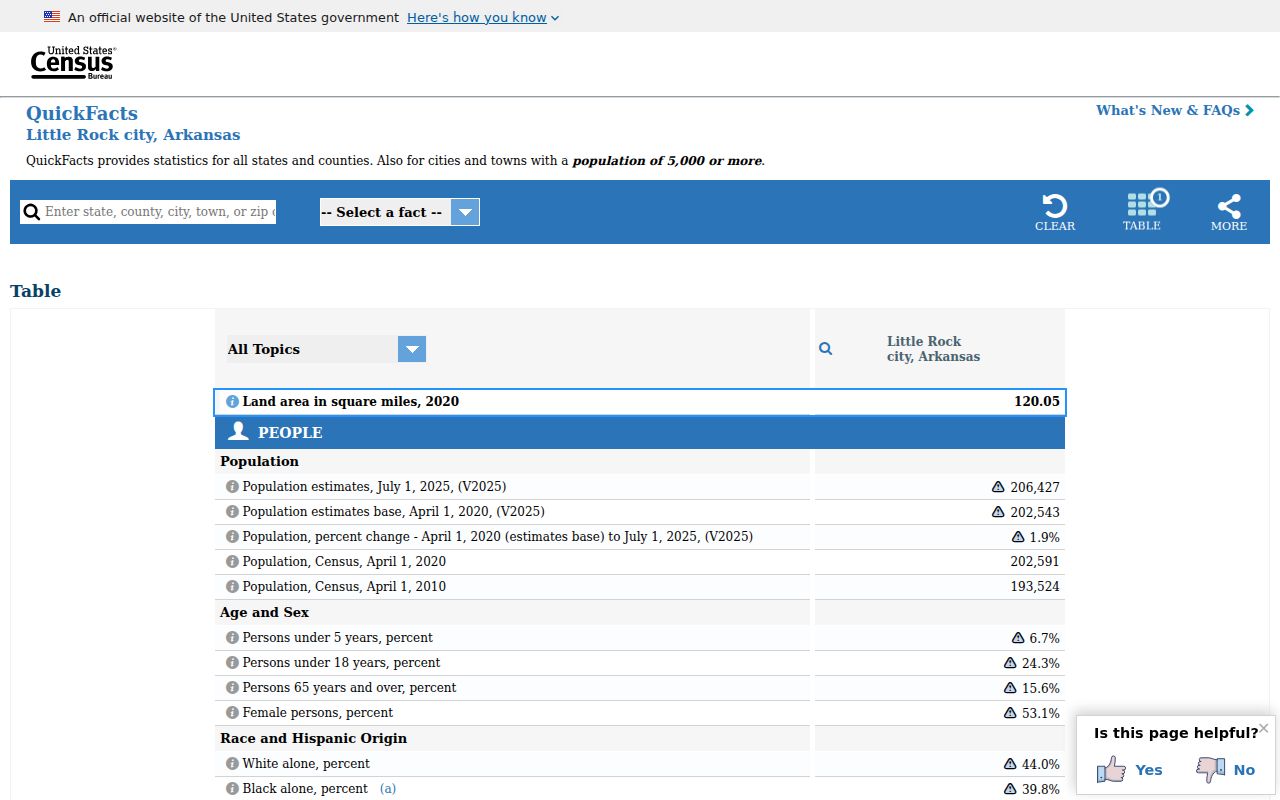
That distinction keeps population context separate from evidence about a specific Little Rock household.